
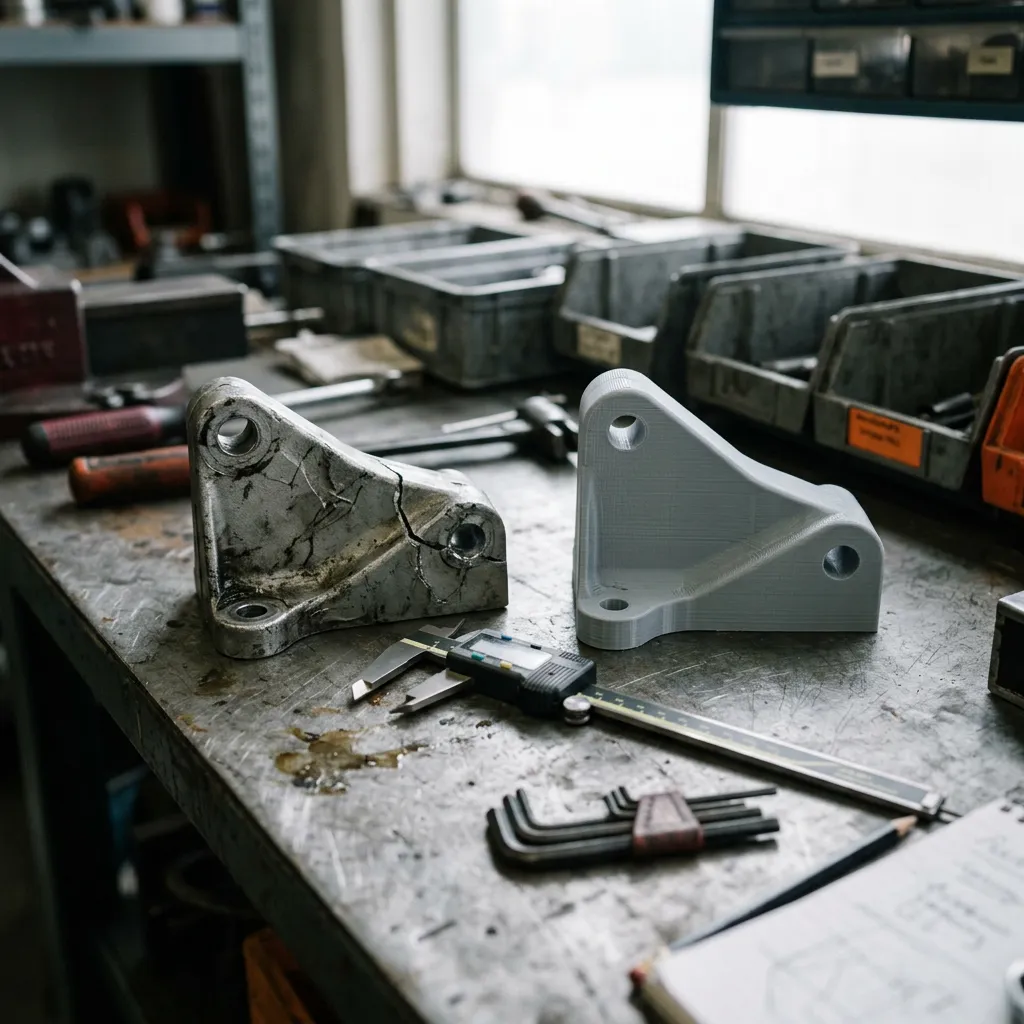
Three ways to have a spare part on hand
A part breaks on a machine, the manufacturer no longer lists it, or you no longer want a production stoppage to depend on a delivery time. For a spare part, 3D printing is one option among others, not a default answer. There are three routes.
- Stock the original part or an equivalent: it is available immediately, but it takes up space, ties up capital and can age on the shelf.
- Have it machined, or made by another conventional process: solid metal or plastic, suited to high loads and to series. You usually need a drawing, sometimes tooling.
- 3D print it: one at a time, without tooling, from a file, within the limits of the materials and of the loads the part has to withstand.
These options are not mutually exclusive. Depending on the part, a printed copy can serve as a temporary fix while you wait for the machined part or the manufacturer's delivery. What matters is choosing with full knowledge of the facts, rather than reopening the debate at every breakdown.
Four criteria for choosing
Go through the criteria in order. A single blocking criterion is sometimes enough to rule out printing.
Availability of the part
If the part is still in the manufacturer's catalogue, with a lead time compatible with your stoppage, order it or keep one in stock. Printing adds nothing, except as a stopgap.
If the part is obsolete, if the manufacturer has gone or if the quoted lead time is incompatible with the machine being down, replacing the obsolete part with a copy, printed or machined, becomes an option worth studying.
Reproducing a part designed by a manufacturer may raise intellectual property questions: if in doubt, check this point before producing a copy.
Quantity
For one part or a few units, printing avoids tooling and the fixed cost that comes with it. This is often where it makes the most sense.
For a recurring need or a longer run, machining, moulding or buying stock regain the advantage. The tipping point depends on the part (size, material, geometry, finish) and is discussed case by case: there is no universal threshold.
Material
3D printing produces parts in engineering polymers, whose properties depend on the technology and the material. The differences between FDM, SLA and SLS and how to choose the right material are covered in dedicated articles.
An original part in steel, brass or bronze that works under hardness, friction or high-temperature conditions is generally a job for machining. For a printed part, strength or temperature resistance values are read from the material manufacturer's technical data sheet, and no further.
Mechanical load and operating conditions
Ask yourself: what load, what impacts, what repeated stresses (fatigue), what vibrations, what temperature, what exposure to chemicals or UV?
A printed part does not always have the same strength in every direction: depending on the process, print orientation matters. As soon as the part is under load, plan a test on the actual machine and keep an eye on it at first. The loads to analyse are listed in the article on adapting a technical part.
When not to print
In several cases, the right answer is not to print, or not as a permanent replacement.
- Safety parts, or parts whose failure puts people at risk (lifting, braking, guarding): a certified part is not replaced by a printed copy.
- Parts subject to regulatory requirements (food contact, medical, pressure): only with a material and a process whose compliance has been demonstrated for that use. Otherwise, no.
- Heavily loaded metal parts or parts in constant friction: machining remains the benchmark.
- Parts quickly available from the manufacturer: order them.
- Long, recurring runs: a conventional process or holding stock is a better fit.
Digital inventory: keeping the file rather than the part
The principle: instead of keeping the spare part on the shelf, you keep its ready-to-manufacture 3D model and produce the part when you need it. Physical stock goes down, and so does the risk of obsolete parts.
This requires a usable file: native CAD or a clean mesh. Record with the file its version (revision), the material, the technology and the settings used, so that the same part can be made again later. If the model is made by a service provider, check who holds the rights to it and on what terms it is handed over to you: this is the subject of the article on the handover of design files. If the file exists but is faulty, see how to prepare and repair your STL files.
The file does not replace validation: a part validated once must be remade under the same conditions. For a critical part, it may still be worth keeping a physical copy as well.
No drawing, no file: taking dimensions from a worn or broken part
Often, the part only exists as a single worn or broken item, with no drawing or file. Before choosing the process, it has to be measured and then remodelled. The approach comes down to four steps.
- Measurement: calipers and micrometer, gauges or templates. For complex geometry, a 3D scan can complement the measurements.
- Interpretation: tell wear apart from the original dimension, identify the functional surfaces (bearing surfaces, bores, threads) and the parts it fits with.
- Tolerances: define the fits the function requires (clearance, interference) and those that can stay loose.
- Remodelling and validation: CAD model, then a fit test on the actual machine, possibly with a first check part.
What helps: every piece of the broken part, photos of the part fitted in its environment, the machine reference and any known dimensions. Once the model exists, the grid above applies: stock, machine or print.
If you use the opportunity to strengthen or modify the part, you move on to adapting a technical part.
In short: which option for which situation
| Situation | Recommended option | Point to watch |
|---|---|---|
| Part in the catalogue, acceptable lead time | Order or stock | Capital tied up in stock |
| Obsolete part, lightly loaded, one or a few units | 3D print | Material per data sheet; intellectual property |
| Loaded metal part (hardness, friction, heat) | Machine | Drawing or dimension survey required |
| Recurring need, longer run | Machining, moulding or stock | Tipping point to study case by case |
| 3D file available, occasional need | Digital inventory | File version, validation |
| Safety or regulated part | Do not print as a replacement | Original certified part |
| Broken part with no drawing | Dimension survey, then choice of process | Tell wear from original dimension |
3D printed spare parts make sense when the part cannot be found, is lightly loaded and is needed in small quantities; elsewhere, machining or stock keep the advantage. Unsure about a part? Send us the part, a drawing or photos for review, or see our 3D design service.
Further reading: adapting a technical part, the technical project study and a project study by Osmoz 3D. For the general background, see additive manufacturing.