
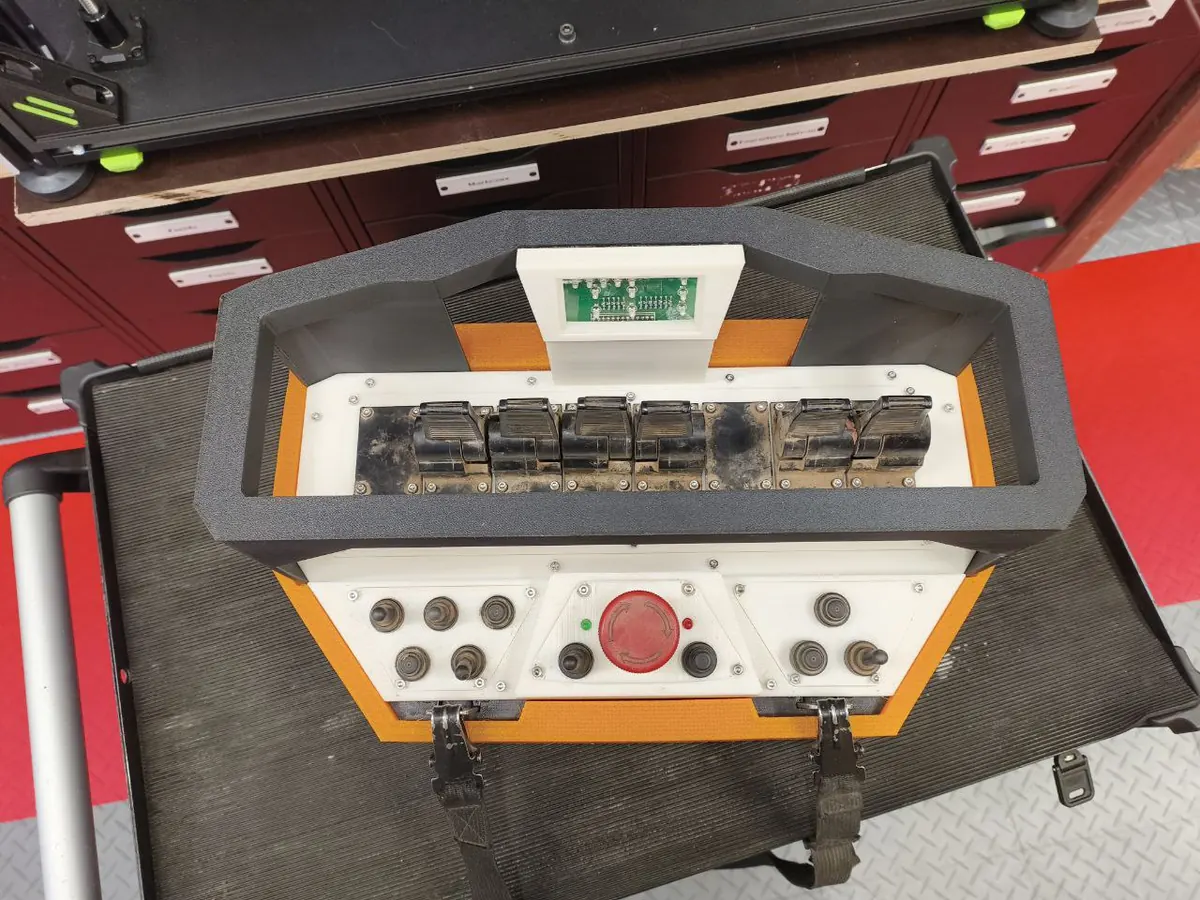
Why adapt rather than replace
Replacing an entire piece of equipment because of a single faulty part is often disproportionate. Adaptation keeps the working hardware in service, curbs spending and reduces waste — and 3D printing makes it very accessible:
- Reproduce an original part faithfully, even one that can no longer be sourced
- Produce quickly, without depending on suppliers
- Optimise the design (strength, ergonomics)
It is also a sustainable move: local production, on-demand manufacturing, very little material waste.
When adaptation becomes the best option
Parts that are unavailable or obsolete
When an older piece of equipment no longer has spare parts, we recreate the component: faithful reproduction, bespoke creation, or reconstruction from photos and drawings.
Optimisation for a specific use
- Adjust the dimensions to suit the environment
- Reinforce identified weak areas
- Add functions (grips, fixings)
- Lighten the part without losing strength
Preventive maintenance
Adapting a part before it fails: creating spare parts to keep in stock, reinforcing sensitive areas, reducing production downtime thanks to immediate replacement.
3D printing in the service of adaptation
Rapid prototyping: a functional prototype in a few hours, improved through iterations, at a controlled cost. Design freedom: complex shapes, customisation of dimensions and fixings, optimised internal structure. Materials to match the constraint:
- PLA — rigid parts, away from high temperatures
- PETG — mechanical and chemical resistance
- ABS — strength and heat resistance
- TPU — flexible, absorbs impacts
- Technical resins (SLA) — high precision
Getting an adaptation right
It all starts with analysis: the part's function, mechanical constraints (tension, compression, torsion, vibration), conditions (humidity, temperature, UV, chemicals), frequency of use and compatibility. Then precise measurements (measurements, 3D scanning, CAD drawings) and the right material/technology pairing.
In short
Adapting through 3D printing combines economy, performance and responsibility — to reproduce an unavailable part, design a bespoke one, or anticipate a breakdown. Have a need? Describe it and we will get back to you with a quote.
In practice: our engineering services adapt the part to its function. Technical context: 3D printing.