
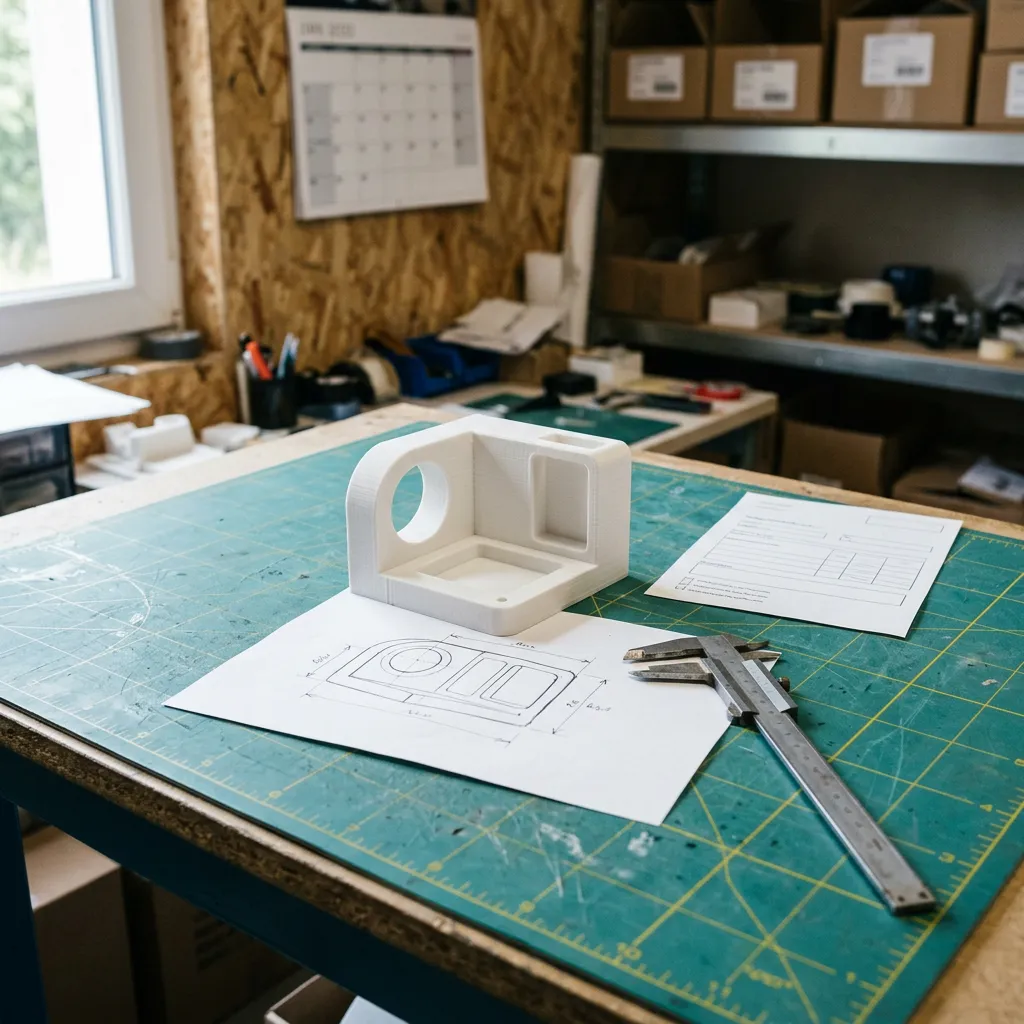
Many organisations have a budget deadline coming up. For some it falls at the end of the calendar year, for others at another date: cycles vary between countries and organisations. Either way, there is money left to commit and a prototype or short run waiting to start. The project is often clear in people's heads, less so on paper. And paper is what a supplier quotes from.
The rules for committing, ordering or invoicing before your budget or financial year closes, whatever its date in your organisation, differ from one company to the next: check with your finance department what has to be done before the date (signed purchase order, delivery, invoice). This article covers the rest: what to send so that the first reply you get is one you can act on.
When you request a 3D printing quote, time is often lost less in manufacturing than in back-and-forth. What quantity? For what use? Is this file the latest version? Every unanswered question costs an email exchange, and therefore days. A complete brief removes most of them.
Below are five headings to fill in, then a brief template. We do not cover what drives the cost here: for that, see how to quickly calculate the price of a 3D print.
The file: the right version, in a usable format
STL is the most widespread format in 3D printing: it describes the surface of the part as a mesh of triangles. It is enough to print a shape as it is. When the part has functional dimensions or will need to be modified, a native CAD format or a neutral exchange format such as STEP (ISO 10303) is more useful: it keeps the exact geometry, whereas STL only holds a faceted approximation. Sending both costs nothing.
Before sending, check:
- units and scale: an STL file does not state its units, and a model drawn in inches but read as millimetres comes out about twenty-five times too small;
- the version: revision and date, so you are not quoted on an outdated file;
- the mesh: closed, with no holes or inverted faces;
- the assembly: separate parts or a single block, depending on what you expect.
No 3D file yet? A dimensioned drawing, a sketch or photos with measurements are enough to start the conversation. Modelling then becomes an extra step to fit into the schedule. For mesh preparation, see preparing and repairing STL files and preparing your 3D print.
Quantity: firm, indicative or tiered
A one-off part, a few prototypes or a short run are not quoted the same way, and the technology chosen may change from one case to another. First, say whether the quantity is firm or indicative.
If it is not settled, ask for a tiered answer, for example 1, 10 and 50 parts (figures given for illustration only). You can then choose without sending a new request, which helps when the budget becomes clearer along the way.
Also mention what may follow: a repeat order, a version 2 after testing. A part that will come back is not prepared like a one-off. If delivery can be split, say so too: a small first batch sometimes lets you validate the part before the rest is launched. For larger volumes, see our short-run page.
Material: describe the use rather than guess a name
When the material is not settled, describing the use beats naming a filament or resin at random. A badly chosen name sends the quote down the wrong track; a description of the use lets the supplier propose the right material.
Questions to ask yourself:
- mechanical loads: impact, bending, friction, clamping;
- operating temperature, continuous and peak;
- exposure: outdoors, UV, humidity, chemicals;
- food or skin contact: this may fall under regulatory requirements (food contact in particular is regulated); flag it in the brief so it is handled as such;
- expected service life: presentation model, test prototype or part in service.
If the part replaces another one, say what the old one was made of and how it failed: a break, a deformation or wear each point towards different choices.
If a specification imposes a material, say so and attach the exact reference. To go further: choosing the right material for your project and, on processes, FDM, SLA or SLS.
Lead time: plan backwards
Start from the real deadline
Three dates often get mixed up: when the part must be used, when it must be delivered, and when the order must be placed. The last one matters for the budget; the first two, for manufacturing. Write all three down.
Work back through the steps
From latest to earliest:
- delivery;
- manufacturing and finishing;
- quote approval and internal purchase order;
- feasibility questions and adjustments;
- sending the brief.
Each step takes time, on your side as on the supplier's. The one most often forgotten is internal sign-off: a purchase order can wait several days for an absent manager's signature. Think about receiving the goods too: if nobody can accept the parcel on certain dates, say so.
Urgent or preferred
Write the mandatory date separately from the preferred one. Flag milestones, for example a prototype to approve before launching the run. Around holiday periods and closing dates, schedules tighten everywhere: ask the supplier about availability in your first message.
Constraints, tolerances and finish: say what really matters
"Maximum precision everywhere" helps no one. A blanket requirement makes manufacturing and inspection heavier without serving the part's function. Point out the critical dimensions instead: a bore, a fit, a bearing surface.
Also specify:
- surface finish and the visible face;
- colour;
- post-processing: sanding, painting, inserts;
- assembly with other parts;
- a marking or engraved reference;
- packaging.
If the part has to fit an existing component, attach that component's file or dimensions: it is what sets the clearances to respect.
An annotated drawing, or a screenshot with the functional areas circled, says more than a long paragraph. If feasibility itself is uncertain, an upstream study phase may be needed: see technical project study: the key step in R&D.
A brief template to copy for your 3D printing quote
Fictional example, to adapt: replace the values in square brackets.
- Subject: [the part and its function, in one sentence]
- Attached file(s): [format, version, units: mm / inches]
- Quantity: [firm / indicative]; tiers requested: [a / b / c]
- Use and environment: [loads, temperature, outdoors, contact…]
- Material: [imposed: reference] or [to be proposed]
- Critical dimensions or areas: [list, or drawing attached]
- Appearance and finish: [surface, colour, post-processing]
- Dates: mandatory delivery [date]; preferred delivery [date]
- Purchasing: [order reference, contact person, delivery address, quote validity required]
- Technical contact: [name, role, phone]
Send everything in a single message, attachments included: one thread saves you from hunting, three weeks later, for the version that was quoted.
Purchasing: the questions to ask internally
Who signs the purchase order? Which document is expected, and by what date? Does a new supplier need to be set up in your system? How long must the quote remain valid for approval to go through? The answers are on your side, and it is better to have them before sending the brief.
After sending: what to expect
A usable reply is more than an amount. It may start with feasibility questions, suggest a technical alternative (another material, another orientation, a part split differently), then lead to a quote to approve. With us, this framing is usually done remotely, in writing or in a short video call: our working manifesto explains why.
A project to launch before the deadline? Send your brief via our contact page.